 Mohammad Kaleem
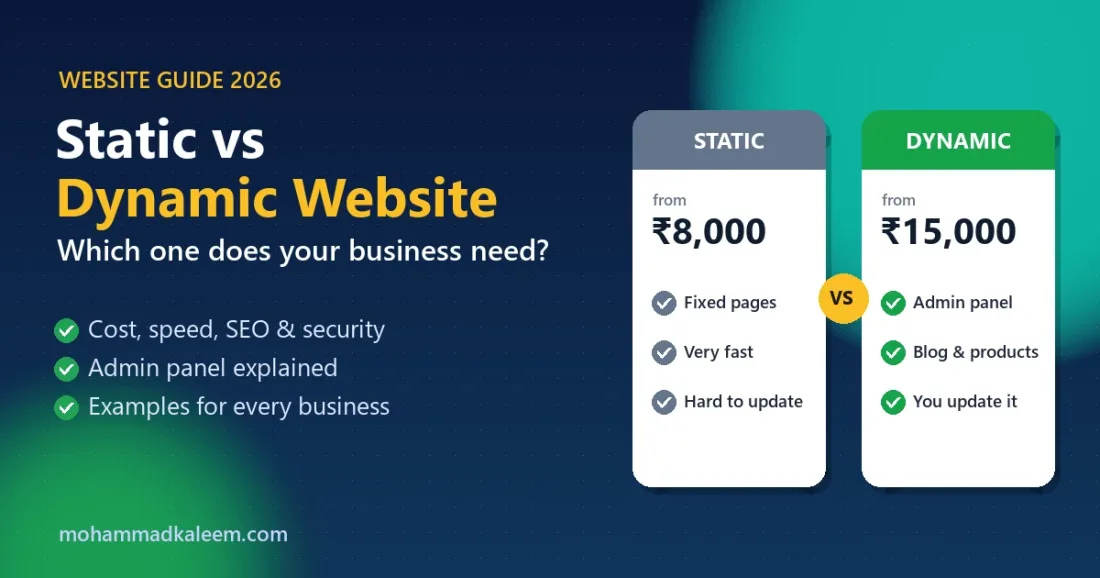
Quick answer: A static website shows the same fixed pages to every visitor, and only a developer can change them. A dynamic website pulls its content from a database, so you can update pages, products and blog posts yourself through an admin panel. Choose static if your content rarely changes and you want the lowest cost (from ₹8,000). Choose dynamic if you update often, want a blog or sell online (from ₹15,000).
When business owners ask me for a website, one of the first decisions is whether it should be static or dynamic. The words sound technical, but the choice is simple once you know what each one does. This guide explains the difference in plain language, compares cost, speed, SEO and security, and tells you which one suits your business.
What Is a Static Website?
A static website is made of fixed pages. Each page is a ready-made file, and every visitor sees exactly the same content. To change the text, a photo or a price, someone has to edit the page's code and upload it again.
A typical static website has a handful of pages, such as Home, About, Services and Contact, with call, WhatsApp and enquiry buttons.
Advantages of a static website
- Lower cost: less to build, so it is the cheapest way to get online.
- Fast loading: pages are ready-made, so they open quickly.
- Fewer security risks: there is no login or database for attackers to target.
- Simple hosting: it runs comfortably on basic hosting.
Disadvantages of a static website
- You cannot update it yourself: every change needs a developer.
- Hard to grow: adding many pages, a blog or products takes manual work.
- Not suitable for selling online: no cart, orders or customer accounts.
What Is a Dynamic Website?
A dynamic website stores its content in a database and builds each page when a visitor opens it. The big advantage for a business owner is the admin panel: you log in, change your services, photos, prices or blog posts, and the website updates instantly, without touching any code.
Online stores, blogs, booking websites and portals are all dynamic. Systems like WordPress, or custom websites built in PHP frameworks such as CodeIgniter or Laravel, are common ways to build them.
Advantages of a dynamic website
- Update content yourself: no need to call a developer for every change.
- Easy to grow: add pages, products and blog posts whenever you want.
- More features: online payments, booking forms, customer logins and enquiry dashboards.
- Better for regular SEO content: publishing blog posts is simple, which helps you rank for more searches.
Disadvantages of a dynamic website
- Higher cost: more to build and test.
- Needs updates and security care: the login and database must be kept secure and backed up.
- Can be slower if built badly: a well-built dynamic site is fast, but a poorly built one can be slow.
Static vs Dynamic Website: Comparison Table
| Static website | Dynamic website | |
|---|---|---|
| Starting price (with me) | ₹8,000 | ₹15,000 (business), ₹25,000 (e-commerce) |
| Who updates content | The developer | You, through an admin panel |
| Speed | Very fast | Fast, if built well |
| Security | Fewer risks | Needs updates and backups |
| Blog | Difficult | Easy |
| Online selling | Not possible | Yes |
| Best for | Small sites that rarely change | Growing businesses and online stores |
Which One Does Your Business Need?
Choose a static website if:
- You need a simple online presence with a few pages.
- Your services and prices rarely change.
- You want the lowest cost and do not plan to write blog posts.
Examples: a local shop, a single consultant, a small clinic or a new business testing the market.
Choose a dynamic website if:
- You will update services, photos, prices or offers regularly.
- You want a blog to bring traffic from Google.
- You want to sell products, take bookings or collect payments online.
- You have many services or locations that each need their own page.
Examples: schools and coaching centres posting updates, restaurants changing menus, real estate businesses adding projects and any online store. I have written separate guides for doctors and clinics, restaurants and cafes and schools and coaching institutes.
Is a Dynamic Website Better for SEO?
Not automatically. Google ranks pages that are fast, mobile-friendly and genuinely useful, whether they are static or dynamic. The real SEO advantage of a dynamic website is that it is easy to keep adding fresh content, such as blog posts and new service pages. If you plan to grow through Google, a dynamic website with an admin panel usually makes that much easier.
Can You Change From Static to Dynamic Later?
Yes. Many businesses start with a static website and move to a dynamic one as they grow. The design can often be kept, while the pages are rebuilt so the content comes from an admin panel. If you think you will need regular updates within a year, it is usually cheaper to start dynamic than to rebuild later.
How Much Does Each Type Cost?
With me, a static website starts at ₹8,000, a business website with an admin panel at ₹15,000 and an e-commerce website at ₹25,000. Domain, hosting and maintenance cost ₹7,500 per year for either type. For a full breakdown, read my guide on website development cost in India, and see how to choose web hosting for the hosting side.
Need Help Choosing?
Tell me about your business and how often you expect to change your content, and I will recommend the right option honestly. If a static website is all you need, that is what I will suggest. See my website design and website development services, or contact me for a free quote on +91 85275 54620.
Frequently Asked Questions
What is the main difference between a static and a dynamic website?
A static website shows fixed pages that only a developer can change. A dynamic website loads content from a database, so you can update it yourself through an admin panel.
Which is cheaper, a static or a dynamic website?
A static website is cheaper. With me, static websites start at ₹8,000 and dynamic business websites with an admin panel start at ₹15,000.
Is a static website faster than a dynamic one?
Usually yes, because its pages are ready-made. A well-built dynamic website can also be fast, but a poorly built one may be slower.
Is WordPress a static or dynamic website?
WordPress is dynamic. It stores content in a database and gives you an admin panel to manage pages and posts.
Do I need a dynamic website for e-commerce?
Yes. An online store needs products, a cart, payments and order management, which all require a dynamic website.
Can I add a blog to a static website?
It is possible, but every post must be added by a developer. If you want to publish blogs regularly, a dynamic website with an admin panel is far easier.